Are Adjustable-Rate Mortgages Making a Comeback — and Are They Right for You?
By Chris JohnsonAugust 6, 2026
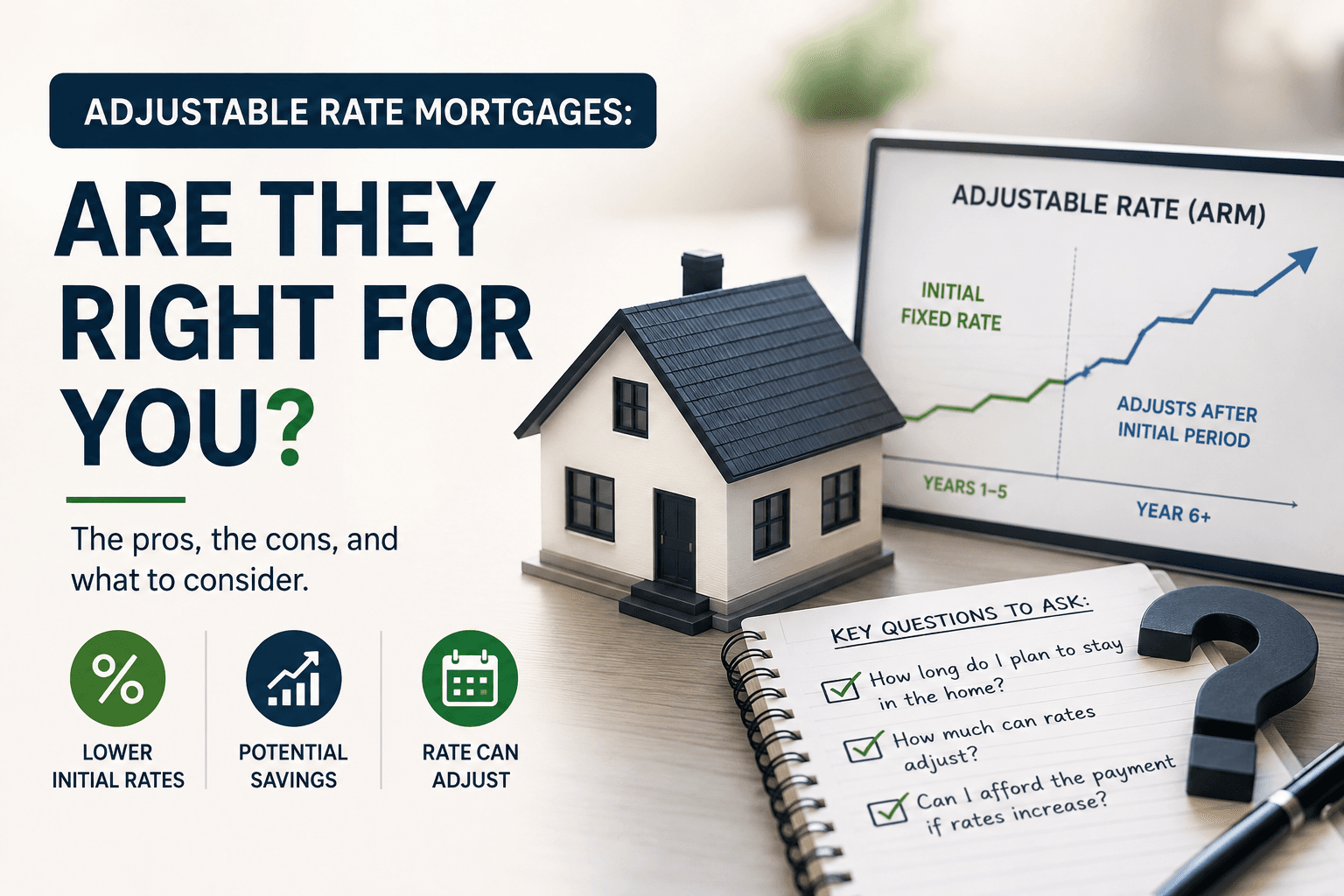
If you've shopped for a mortgage in the last few months, you've probably noticed something: adjustable-rate mortgages, or ARMs, are back in the conversation. Nationally, ARM volume has climbed to its highest level since 2023.
That's not an accident. ARM applications are up sharply year-over-year as buyers look for ways to make today's rate environment pencil out, especially here in Santa Clara County where the median purchase is a jumbo loan by default. Let's walk through what's actually driving this, and — more importantly — how to know if an ARM makes sense for your situation.
Why ARMs Are Suddenly Popular Again
The math is simple: ARMs are pricing meaningfully below fixed-rate loans right now. As of this week, the average 30-year fixed sits in the mid-6% range, while 5/1 ARM rates are running roughly half a point to three-quarters of a point lower. On a $1 million-plus loan — a normal purchase price in much of Santa Clara County — that spread can mean several hundred dollars a month in savings during the initial fixed period.
There's also a behavioral shift. A lot of today's ARM borrowers are choosing them deliberately, not out of desperation, betting that rates ease in the next few years or planning to sell or refinance before the adjustable period kicks in. It's a "buy now, refinance later" mindset rather than the reach-for-anything borrowing that characterized ARMs before 2008.
How an ARM Actually Works
An ARM starts with a fixed introductory rate for a set number of years — most commonly 5, 7, or 10 — and then adjusts periodically based on a market index. A "5/1 ARM" means your rate is locked for 5 years, then can adjust once a year afterward.
Modern ARMs come with rate caps built in — typically structured like 2/2/5 or 5/2/5 — that limit how much your rate can move at the first adjustment, at each adjustment after that, and over the life of the loan. This is one of the biggest differences from the pre-2008 era, when caps were looser or absent entirely.
How to Know If an ARM Makes Sense for You
- Think honestly about your timeline. If there's a good chance you'll sell or refinance within 5–7 years, an ARM lets you capture savings during the years you're actually likely to hold the loan.
- Stress-test the worst case, not just the best case. Ask your loan officer to show you what your payment looks like at the maximum allowable rate after adjustment.
- Consider your income trajectory. ARMs tend to make the most sense for buyers who reasonably expect their income to rise.
- Run the real dollar comparison on your specific loan size. The savings gap between ARM and fixed widens as your loan amount grows, which matters a lot on jumbo purchases.
- Ask about caps and worst-case payment before you commit.
Bay Area note: Because so many Santa Clara County purchases fall into jumbo territory, the dollar impact of choosing an ARM over a fixed-rate loan is often larger here than the national averages suggest.
Where rates stand right now (as of August 6, 2026): 30-Yr Fixed ~6.67% · 15-Yr Fixed ~5.98% · 5/1 ARM (APR) ~6.20%. Jumbo 30-year fixed is averaging closer to 6.8% nationally this week.
Frequently Asked Questions
Are ARMs safe now, or is this like 2008 again?
Today's ARMs are structurally different from the pre-crisis products. Rate caps are standard, underwriting is stricter, and lenders are required to qualify you based on what you could realistically pay after adjustment.
How much could my payment actually go up when it adjusts?
It depends entirely on your loan's specific cap structure — commonly 2/2/5 or 5/2/5.
Is an ARM a good fit if I might sell or refinance in a few years?
This is often exactly the buyer profile where an ARM makes the most sense.
Should I wait for rates to drop further instead of choosing an ARM now?
Timing the market perfectly isn't realistic for most buyers. An ARM is one way to make today's affordability work without betting your whole plan on a future rate drop.
Chris Johnson | Associate Broker | Affinity Mortgage | NMLS #235072 | Company NMLS #252576 | Equal Housing Lender. Rate and payment examples are illustrative only and not a quote for any specific loan.
Chris Johnson is a dual-licensed California Real Estate Broker (DRE #01131369) and Mortgage Loan Originator (NMLS #235072) serving Santa Clara County and the Bay Area.
Ready to talk financing?
Get straight answers on rates, programs, and what you qualify for.