Condo vs. Single-Family Financing in Santa Clara County: What's Different in 2026
By Chris JohnsonOctober 21, 2026
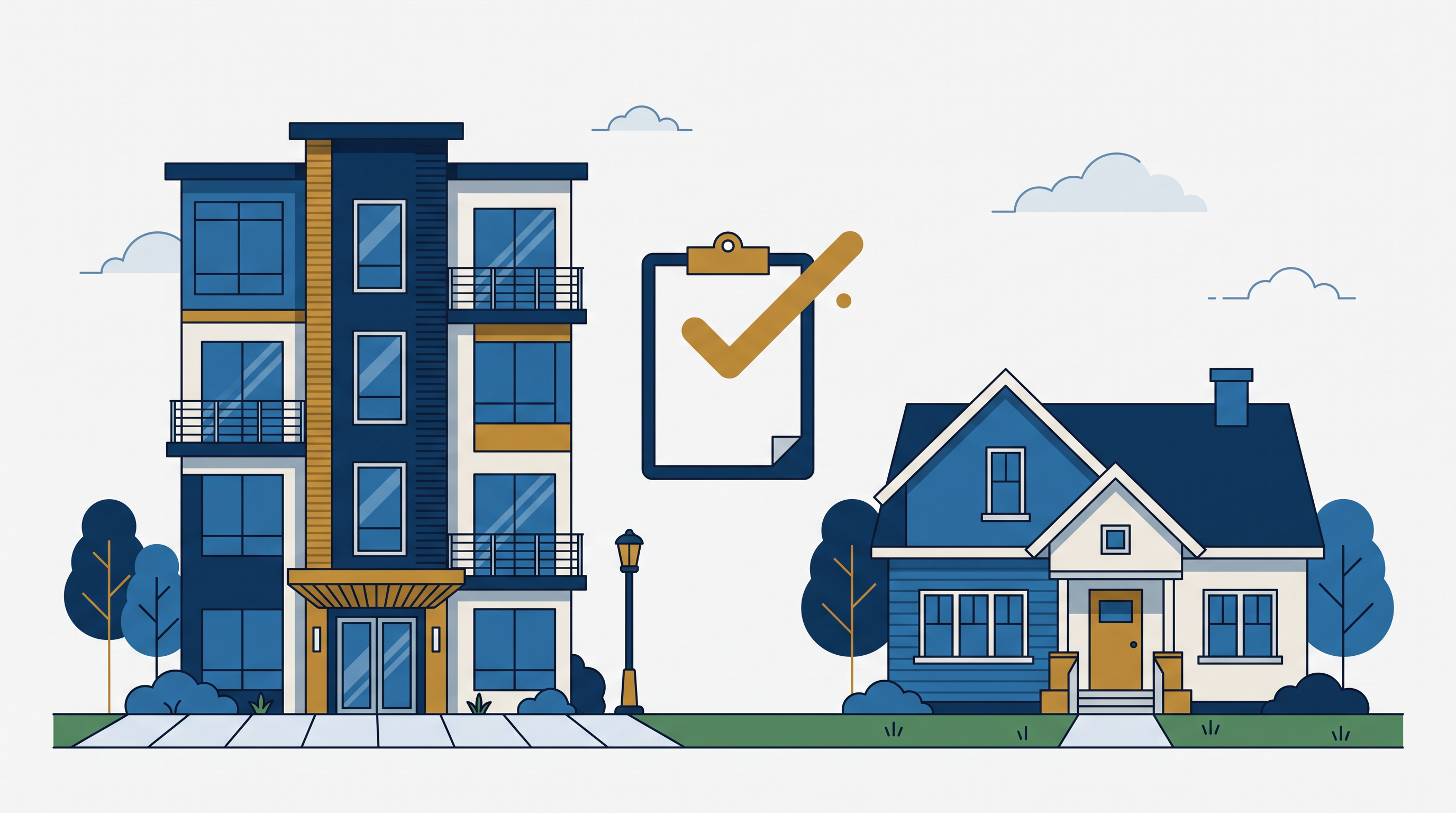
Direct answer: Financing a condo means the lender approves two things instead of one: you and the building. On a single-family home, the lender looks at your finances and the property. On a condo, they also review the homeowners association — its budget, reserves, insurance, special assessments, and any litigation — and a building that doesn't pass can't be financed with a standard conventional loan, no matter how strong your credit is. That review got stricter in 2026: for loan applications dated on or after August 3, the streamlined "limited review" is gone, so most conventional condo loans now go through a full project review. In Santa Clara County, where the average condo sells for roughly $977,000 — well under the $1,249,125 conforming loan limit — these are the rules you're most likely to run into.
If you've only ever thought about financing a house, a condo adds a step that catches a lot of buyers off guard: the lender has to approve the building, not just you. You can have excellent credit, a solid down payment, and a clean file, and still run into trouble if the association's finances don't pass review. Here's what that means in plain English.
Why Condo Loans Get an Extra Layer of Review
When you buy a condo, you own your unit, but you also share ownership of — and financial responsibility for — everything else: the roof, the elevators, the pool, the parking structure. If the association is underfunded, that risk lands on every owner, which is why lenders care about the building's financial health almost as much as yours. Underfunded reserves are the usual culprit: when a major component fails and the money isn't there, owners get hit with a special assessment, and an owner facing a surprise bill is more likely to fall behind on their mortgage.
What Changed for 2026
- Limited review is gone. For loan applications dated on or after August 3, 2026, most conventional condo loans go through a full project review (a few smaller projects can qualify for a waiver). Lenders now look closely at the HOA budget, reserve study, board minutes, insurance, special assessments, litigation, and deferred maintenance.
- Reserve requirements are rising. Fannie Mae is raising the minimum reserve funding for condo associations from 10% to 15% of budgeted assessment income, starting with loan applications dated in early 2027.
- Underfunded or underinsured buildings can be ruled ineligible. If a project is flagged, a standard conventional loan isn't available to any buyer in that building, which can shrink the pool of buyers and affect resale.
The practical takeaway: the building you choose now matters to your financing as much as the unit does. It's worth finding out as early as you can whether your lender can actually finance that particular building.
Conventional, FHA, VA, and Jumbo — How Each Handles Condos
| Loan Type | What the Building Needs | What to Know |
|---|---|---|
| Conventional | Passes Fannie Mae / Freddie Mac project review (or qualifies for a waiver) | Strict on reserves, insurance, special assessments, and litigation |
| FHA | On HUD's approved condo list, or qualifies for single-unit approval | HUD limits how many units in a non-approved building can carry FHA insurance |
| VA | Building must be VA-approved | Same no-monthly-mortgage-insurance advantage as a VA house, but only in approved projects |
| Jumbo | Set by each lender | Requirements vary widely and are often tighter on down payment and project review |
FHA is the path people most often overlook. If a building isn't on HUD's approved list, single-unit approval (formerly called "spot approval") can still make an FHA loan possible on one unit, as long as the building meets HUD's standards for insurance, finances, and owner-occupancy. It takes more paperwork, so start early.
HOA Dues Count in Your Qualifying Math
Your monthly HOA dues get added to your housing payment when a lender calculates your debt-to-income ratio. That means a condo with a lower price but higher dues can qualify more like a pricier home than you'd expect. I walk through the full DTI math in How Lenders Actually Calculate How Much Home You Can Afford. And if you're putting down less than 20%, mortgage insurance applies to condos too — here's how PMI, MIP, and the VA funding fee differ.
Santa Clara County: Condos vs. Single-Family Homes Right Now
Here's how the two markets compared in September, according to the latest county report:
| Measure | Condos | Single-Family |
|---|---|---|
| Average sale price | $976,884 | $2,473,200 |
| Median price vs. last year | -8.1% | -1.5% |
| Sale price vs. list price | 100.1% | 103.6% |
| Days of inventory | 89 | 45 |
| Days to sell | 39 | 26 |
| Homes for sale (Oct. 5) | 711 (+17.9% vs. last year) | 993 (+18.6% vs. last year) |
Source: Santa Clara County Real Estate Market Trends Report, September 2026.
Condo buyers have more room than single-family buyers right now: prices are lower than a year ago, condos are selling right at list price instead of above it, and it would take roughly twice as long to sell the current condo inventory. That generally means more room to negotiate. It also means a building's HOA health matters even more when you eventually sell, since your future buyer will have plenty of other choices.
Rate Environment This Week: The 30-year fixed averaged 7.40% in Freddie Mac's most recent weekly survey (October 15), unchanged from the week before and up from 6.65% in mid-August. That's a national average for conventional loans with 20% down and excellent credit — condo loans, smaller down payments, and jumbo loans can price differently. Call or text (408) 687-6109 for what today's environment means for your specific scenario.
How to Vet a Condo Before You Fall in Love With It
- Ask for the HOA documents early. Budget, reserve study, meeting minutes, insurance certificate, and special assessment history tell you most of what a lender will look at.
- Check how well the association funds its reserves. Ask what share of the annual budget goes to reserves. A low number is a warning sign for future special assessments.
- Ask about special assessments and litigation. Anything pending or recent can affect both your financing and your monthly costs.
- Confirm your loan program can finance this building. Have your lender check conventional, FHA, or VA eligibility for the project, ideally before you write an offer.
- Add HOA dues to your payment math. Principal and interest alone won't show you what the home really costs each month.
- Think about resale. A building that's hard to finance is harder to sell, which can affect its value down the road.
Frequently Asked Questions
Why is financing a condo different from financing a house?
With a house, the lender evaluates you and the property. With a condo, the lender also evaluates the homeowners association, because owners share responsibility for the building. Lenders review the HOA's budget, reserve funding, insurance, special assessments, and litigation, and a building that doesn't meet standards can be ineligible for conventional financing regardless of the borrower's credit.
What does "non-warrantable condo" mean?
A non-warrantable condo is a building that doesn't meet Fannie Mae and Freddie Mac's project standards — for example, because of underfunded reserves, pending litigation, or inadequate insurance. Loans on these units can't be sold to Fannie Mae or Freddie Mac, so they typically go through lenders with their own guidelines, which often means a larger down payment and a higher rate. Your lender can check a building's status before you write an offer.
Can I use an FHA loan to buy a condo?
Yes, if the building is on HUD's approved condo list or the unit qualifies for FHA single-unit approval, formerly known as spot approval. HUD limits how many units in a non-approved building can carry FHA insurance, so it depends on the building. Your lender can check the project's status.
Do HOA dues affect how much I can borrow?
Yes. Lenders add your monthly HOA dues to your housing payment when calculating your debt-to-income ratio, so higher dues can reduce the loan amount you qualify for, even if the purchase price is lower.
Have a Condo in Mind?
Every building is different, and the HOA's numbers can change what's possible for your loan. Let's talk through what a lender will look at. Start Your Pre-Approval or Book a 15-Minute Call.
If you're weighing a condo against a single-family home, that's exactly the conversation I like having before you start touring. Reach me directly at (408) 687-6109, email chris_j@ouraffinity.com, or grab a time on my calendar: calendly.com/yourcaliloanpro.
Equal Housing Lender. Chris Johnson | Associate Broker | Affinity Mortgage | NMLS #235072 | Affinity Mortgage NMLS #252576 | 2542 S Bascom Ave, Suite 185, Campbell, CA 95008 | Equal Housing Lender. This blog post is for informational purposes only and does not constitute a commitment to lend. Loan approval is subject to credit approval and program guidelines. Interest rates and program terms are subject to change without notice. Not a solicitation if you are already represented by a real estate professional.
Chris Johnson is a dual-licensed California Real Estate Broker (DRE #01131369) and Mortgage Loan Originator (NMLS #235072) serving Santa Clara County and the Bay Area.
Ready to talk financing?
Get straight answers on rates, programs, and what you qualify for.