How Much Money Do You Actually Need to Buy a Home in San Jose?
By Chris JohnsonJune 26, 2026
It's the first question almost every buyer asks me, usually in a whisper, as if they're afraid of the answer: "How much money do I actually need to buy a home in San Jose?"
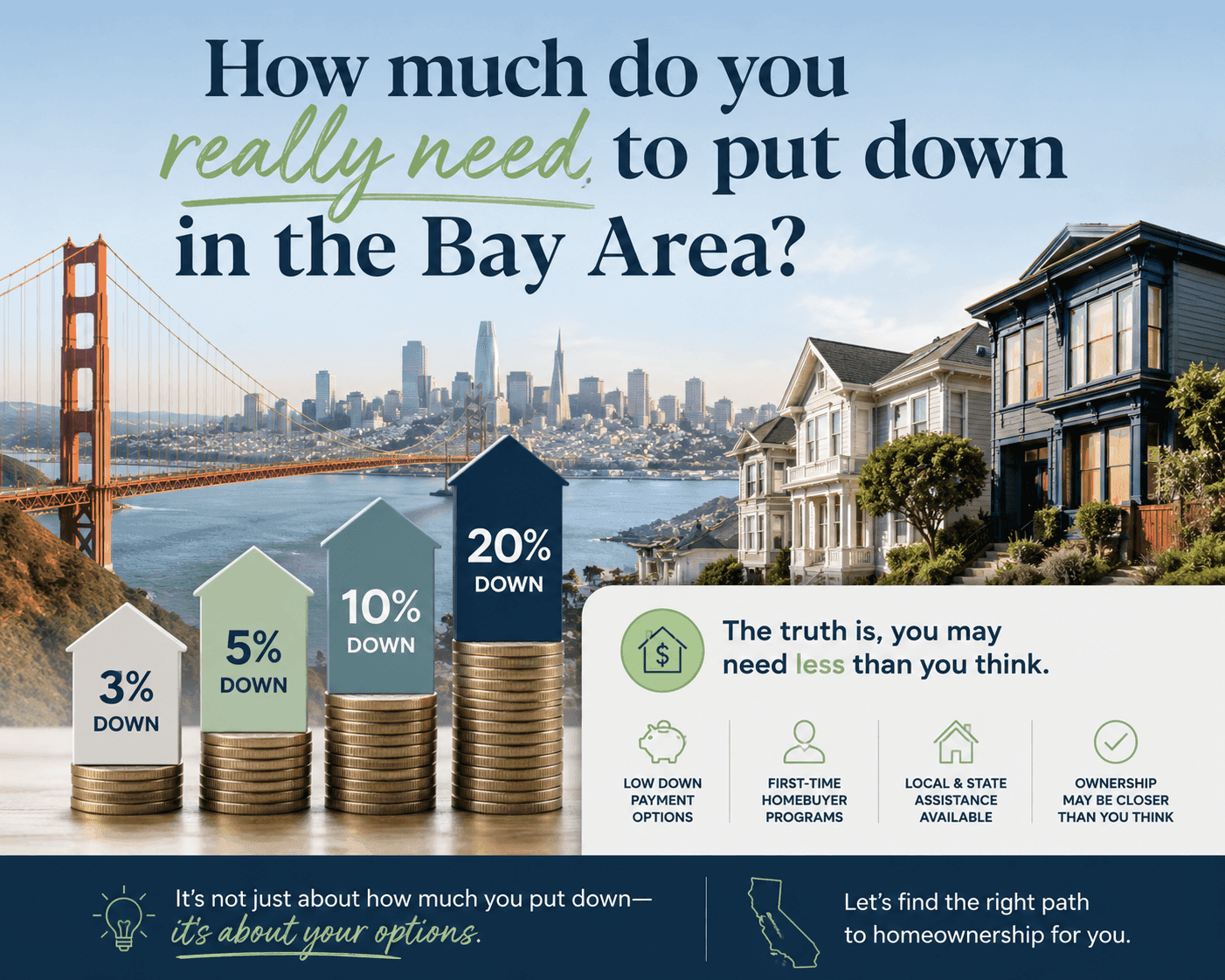
The honest answer is: probably less than you think — and the exact number depends on far more than just the purchase price. The 20% down myth that stops a lot of people from even exploring homeownership is just that: a myth.
Short answer: In Santa Clara County, you can qualify for a home loan with as little as 3% to 5% down, depending on the loan program and purchase price. A true 20% down payment is not required for most buyers.
How This Works in Santa Clara County: The Three Loan Tiers
Because Santa Clara County is designated a high-cost area, buyers have access to programs with lower down payment requirements at much higher purchase prices than most of the country. For 2026:
Tier 1 — Standard Conventional (loan up to $832,750): As little as 3% down for qualified buyers. Lowest rates, most flexible programs.
Tier 2 — High-Balance Conforming (loan $832,750–$1,249,125): As little as 5% down on a primary residence. Still Fannie/Freddie backed.
Tier 3 — Jumbo (loan above $1,249,125): Typically 10–20% down depending on the program. Stricter credit and income requirements.
These tiers refer to your loan amount, not the purchase price. If you're purchasing a home priced at $1.4 million and bring a larger down payment that reduces your loan below $1,249,125, you can potentially stay in Tier 2 rather than moving into jumbo territory.
Common Misunderstandings About Down Payments in the Bay Area
"I need 20% down to buy a house." Conventional loans are available with as little as 3% down in Tier 1, and 5% in Tier 2. The 20% threshold eliminates PMI — it is not a requirement to qualify.
"Down payment assistance programs don't work in a market like this." Several programs — including California's Dream For All program and county-level options — are specifically available in high-cost areas, with higher income limits than most of the state.
"Jumbo loans require 20% down, period." Jumbo programs vary by lender, and some allow as little as 10% or lower in certain scenarios.
"PMI is a permanent cost." PMI can be removed once you've built sufficient equity — typically when your loan balance reaches 80% of the home's value.
What to Think About Before Deciding How Much to Put Down
- Cash reserves after closing. Lenders and financial advisors generally want to see 3–6 months of expenses in reserve after you close.
- How long you plan to stay. The longer your time horizon, the more upfront costs are amortized across the benefit of owning.
- Competing financial priorities. High-interest debt, retirement contributions, and other investments all compete with a down payment for the same dollars.
- Offer competitiveness. A larger down payment can sometimes strengthen an offer in a competitive market.
- The loan tier math. Strategic down payment sizing can keep you within a more favorable loan tier.
- Gift funds and down payment assistance. Rules vary by loan type — worth discussing before you start shopping.
Frequently Asked Questions
Do I really need 20% down to buy a home in San Jose?
No. The 20% threshold is the point at which PMI is no longer required — not a requirement to qualify. Qualified buyers can access financing with as little as 3-5% down depending on loan tier.
What is the jumbo loan threshold in Santa Clara County for 2026?
$1,249,125 for a single-family home — significantly higher than the national baseline of $832,750.
Are down payment assistance programs available for Santa Clara County buyers?
Yes, though availability and terms change frequently — verify directly with a licensed mortgage professional.
What is PMI and how do I get rid of it?
A monthly premium charged when you put down less than 20% on a conventional loan. Lenders must automatically cancel it at 78% loan-to-value, and you can request removal at 80%.
I'm self-employed. Does that make it harder to qualify?
It adds complexity to documentation but doesn't disqualify you. Bank statement loan programs and certain non-QM products are designed specifically for self-employed borrowers.
Chris Johnson | Associate Broker | Affinity Mortgage | NMLS #235072 | Company NMLS #252576 | Equal Housing Lender.
Chris Johnson is a dual-licensed California Real Estate Broker (DRE #01131369) and Mortgage Loan Originator (NMLS #235072) serving Santa Clara County and the Bay Area.
Ready to talk financing?
Get straight answers on rates, programs, and what you qualify for.